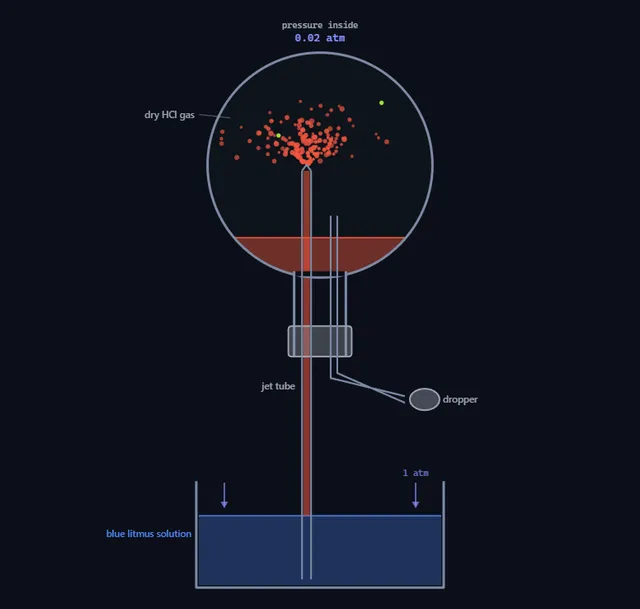
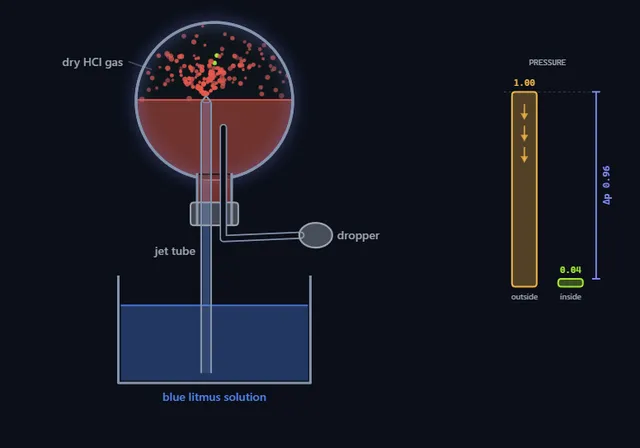
Study of Compounds — Gas Evolution & Confirmatory Tests
Step through the standard tests for HCl, NH₃, HNO₃ and H₂SO₄ and see each gas and its confirmatory test.
About this simulation
A guided bench spanning all four Study of Compounds groups. Students pick a group — sulphuric acid, hydrochloric acid, nitric acid or ammonia — and a test, then step through it: the bench adds each reagent in turn, heats where the reaction needs it, and brings in the confirming paper or rod, with the observation and the balanced equation at every step. The gases are confirmed the standard way — acidified K₂Cr₂O₇ paper turning orange to green for SO₂, an ammonia-wetted rod giving dense white fumes with HCl, a conc.-HCl rod doing the same for NH₃. Alongside them run the qualitative tests: AgNO₃ + HCl giving curdy white AgCl that redissolves in excess ammonia, BaCl₂ + H₂SO₄ giving white BaSO₄, and CuSO₄ + NH₄OH stepping from a pale-blue hydroxide precipitate to the deep-blue tetraamminecopper(II) complex. Thirteen guided tests in all: three each for sulphuric, hydrochloric and nitric acid, four for ammonia.
How to use it
- Pick a 'Gas' group (H₂SO₄, HCl, HNO₃ or NH₃), then choose a test with 'Test in this group'.
- Set 'Step' to 0 for a clean flask and raise it one step at a time: the bench adds each reagent, applies heat or brings in the test paper or rod in order.
- Watch the flask after each step and read the observation and the balanced equation printed beside it.
- At the last step, watch the paper or rod at the mouth of the flask, such as acidified K₂Cr₂O₇ paper turning from orange to green or dense white fumes at the rod.
- Try the presets, for example 'AgCl dissolves in excess ammonia' or 'Cu(OH)₂ → deep-blue tetraammine', to jump straight to a result.
What to notice
- Several reactions need heat: stop the step slider just before 'heat' and the bench reports that the mixture is ready, with no gas yet.
- Copper with concentrated nitric acid gives dense reddish-brown NO₂, while copper with concentrated sulphuric acid gives colourless SO₂; both leave a blue copper salt solution.
- HCl and NH₃ confirm each other: an ammonia rod held over HCl, or a conc. HCl rod over NH₃, gives the same dense white fumes of NH₄Cl.
- Adding ammonia solution to copper sulphate first gives a pale-blue precipitate of Cu(OH)₂, which dissolves in excess ammonia to a deep-blue solution.
The formulas
- Cu + 2H₂SO₄ (conc.) → CuSO₄ + 2H₂O + SO₂↑
- Hot concentrated sulphuric acid oxidises copper, giving sulphur dioxide that turns acidified potassium dichromate paper from orange to green.
- Cu + 4HNO₃ (conc.) → Cu(NO₃)₂ + 2H₂O + 2NO₂↑
- Concentrated nitric acid oxidises copper, giving reddish-brown nitrogen dioxide and blue copper nitrate.
- AgNO₃ + HCl → AgCl↓ + HNO₃
- Chloride ions give a curdy white precipitate of silver chloride, which dissolves in excess ammonia solution.
Questions
How do you test for sulphur dioxide gas?
Hold a strip of filter paper dipped in acidified potassium dichromate solution at the mouth of the tube. Sulphur dioxide is a reducing agent: it reduces orange dichromate (Cr₂O₇²⁻) to green chromium(III) ions, so the paper turns from orange to green. In the simulation, run H₂SO₄ test 1, 'Copper → SO₂', to its final step to see the paper change.
How is hydrogen chloride gas distinguished from ammonia gas?
Both give dense white fumes of ammonium chloride when they meet each other, so that test alone does not tell them apart. Use moist litmus: HCl turns blue litmus red because it is acidic, while ammonia turns red litmus blue because it is alkaline. HCl also gives a curdy white precipitate with silver nitrate, and ammonia turns Nessler's reagent brown.
What is observed when ammonia solution is added to copper sulphate solution, first in small amounts and then in excess?
A few drops of ammonium hydroxide give a pale-blue precipitate of copper(II) hydroxide. When more ammonia solution is added, the precipitate dissolves and the solution turns deep blue (inky blue) because the soluble complex tetraamminecopper(II) sulphate, [Cu(NH₃)₄]SO₄, forms. Step through NH₃ test 3, 'Passed into copper sulphate', to see both stages.
How do you confirm that a solution contains a chloride using silver nitrate?
Add silver nitrate solution to the solution acidified with dilute nitric acid. A chloride gives a curdy white precipitate of silver chloride, which does not dissolve in dilute nitric acid but dissolves in excess ammonium hydroxide, forming the soluble complex [Ag(NH₃)₂]Cl. In the simulation, HCl test 2, 'Silver nitrate → AgCl', shows the precipitate and then its disappearance.
Why does concentrated nitric acid give brown fumes on heating?
Concentrated nitric acid is unstable and decomposes on heating into nitrogen dioxide, water and oxygen: 4HNO₃ → 4NO₂ + 2H₂O + O₂. Nitrogen dioxide is a reddish-brown gas, so brown fumes appear. The same decomposition, slowly in light, is why stored nitric acid turns yellow and is kept in brown bottles. Try HNO₃ test 2, 'Heat conc. HNO₃ → NO₂'.
Related simulations