Fountain Experiment — Solubility of HCl Gas
Squeeze in water, watch the pressure collapse and the atmosphere push up a red fountain.
About this simulation
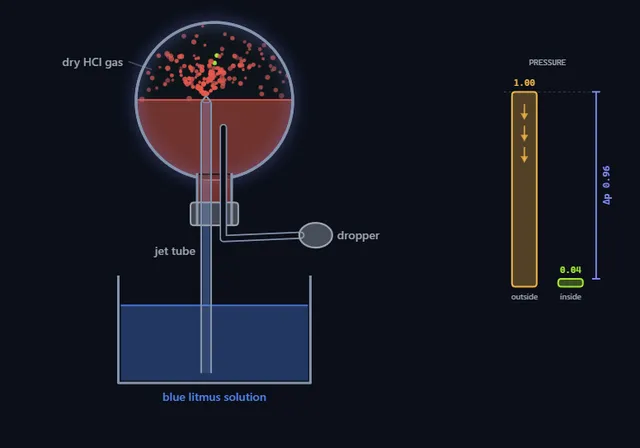
The classic demonstration that HCl gas is extremely soluble in water and acidic in solution. A dry flask of HCl is fitted with a jet tube dipping into blue litmus solution and a dropper of water; squeezing the dropper dissolves the gas almost completely, creating a partial vacuum, so the outside atmospheric pressure drives the litmus up the jet tube where it bursts out as a red fountain. Students vary the water squeezed in and the flask volume and switch the gas between HCl, NH₃, CO₂ and O₂, watching the pressure inside, Δp and the water column that Δp can support (1 atm ≡ 1033 cm) decide whether a fountain happens at all. The gas comparison separates the two conclusions students routinely conflate: the fountain proves high solubility, while the colour change proves acidity — NH₃ is just as soluble and gives just as strong a fountain, but the litmus stays blue.
How to use it
- With 'Gas in the flask' on HCl, let the demonstration play: a few drops enter from the dropper, the gas dissolves and blue litmus shoots up the 40 cm jet tube as a red fountain.
- Watch the PRESSURE bars beside the flask: the inside bar collapses while the outside stays at 1 atm, and the Δp label shows the difference.
- Switch the gas to NH₃: the fountain is just as strong, but the litmus stays blue.
- Try CO₂ and O₂ and read the line under the heading at the top: CO₂ gives 'Liquid rises only' and O₂ gives 'Nothing happens', as the pressure barely changes.
- Lower 'Water squeezed in' and raise 'Flask volume' (the 'Barely enough water' preset) to find where the lift only just reaches the 40 cm jet.
What to notice
- The fountain is driven by the outside air: once the gas dissolves, the pressure inside the flask falls and atmospheric pressure pushes the liquid up the jet tube.
- A fountain needs a very soluble gas. HCl and NH₃ dissolve in hundreds of times their own volume of water, while CO₂ and O₂ dissolve far too little.
- The strength of the fountain and the colour of the litmus answer different questions: the fountain shows solubility, the colour shows whether the solution is acidic.
- The 'Δp lifts … of water' heading is a capacity: a pressure drop of almost 1 atm could hold up about 10 m of water, far more than the 40 cm tube.
The formulas
- p(inside) = 1 − (Vw · s / Vf) atm
- Pressure left in the flask after water volume Vw dissolves s volumes of gas per volume of water from a flask of volume Vf (the simulation caps the fraction dissolved at 98%).
- h = Δp × 1033 cm
- Height of water column the pressure difference Δp (in atm) can support, since 1 atm equals about 1033 cm of water.
- HCl(g) + H₂O(l) → H₃O⁺(aq) + Cl⁻(aq)
- Hydrogen chloride ionises in water to give hydronium ions, which turn blue litmus red.
Questions
What does the fountain experiment prove about hydrogen chloride gas?
It proves two things: that HCl gas is extremely soluble in water and that its solution is acidic. The few drops of water dissolve so much HCl that a partial vacuum forms and the atmosphere forces the liquid up as a fountain. Because blue litmus turns red as it enters the flask, the dissolved gas must be acidic. In the simulation, the PRESSURE bars show the collapse.
Why does water rush into the flask in the fountain experiment?
Water is not sucked in; it is pushed. When the gas dissolves, fewer gas molecules remain inside, so the pressure in the flask drops well below the atmospheric pressure acting on the surface of the trough. That pressure difference forces the liquid up the jet tube. In the simulation the outside bar stays at 1 atm while the inside bar falls, and the Δp label shows the push.
Why must the flask be completely dry for the fountain experiment?
HCl is so soluble that any moisture left in the flask would dissolve the gas before the experiment begins. The pressure would drop too early, and there would be little gas left to dissolve when the dropper is squeezed, so the fountain would be weak or absent. For the same reason the gas is dried before it is collected.
Can ammonia gas be used for the fountain experiment?
Yes. Ammonia is even more soluble in water than hydrogen chloride, so it gives an equally strong fountain. The difference is colour: ammonia solution is alkaline, so blue litmus stays blue, while red litmus or phenolphthalein would show the change. Select NH₃ in the simulation: the fountain is just as strong but stays blue, showing that the fountain proves solubility, not acidity.
Why does carbon dioxide not give a fountain?
Carbon dioxide dissolves in roughly its own volume of water, so a few drops of water remove only a tiny fraction of the gas. The pressure inside hardly falls, and the small pressure difference can lift the liquid only a few centimetres. Select CO₂ in the simulation and the line at the top reads 'Liquid rises only': the liquid never reaches the top of the 40 cm jet.
Related simulations