Relative Velocity — The River Crossing (Explainer)
A guided, step-by-step walkthrough of the river-crossing vectors.
About this simulation
A narrated, step-by-step version of the river-crossing problem — it plays through the boat velocity, the current velocity and their resultant as building vectors, so the relative-velocity reasoning is unmistakable before students experiment on their own.
How to use it
- Press play and let the eight scenes run in order, or tap the Scene buttons 1 to 8 to jump to one; the title at the top of the picture names the step.
- Choose a voice in the Narration menu if you want each scene read aloud; it is off by default.
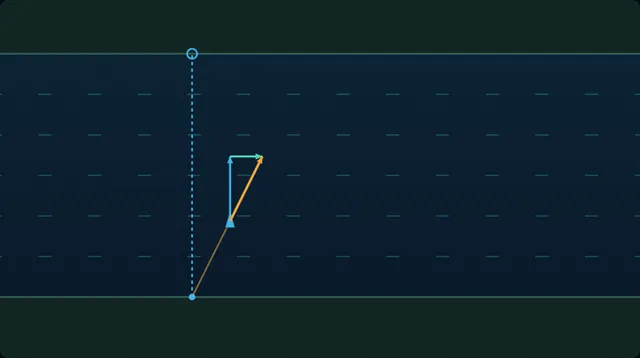
- Tap The vector triangle under Try to see the boat and current arrows joined head to tail, with the amber resultant from start to finish.
- Tap Crossing, with drift, then Aimed upstream — zero drift, and compare the two landings: the amber drift bracket on the far bank in scene 6, and the scene 7 caption saying that at 30° the drift is zero.
- End on Both landings, side by side to see the 10 m drift path and the straight path drawn together.
What to notice
- The walkthrough uses fixed numbers: a 20 m river, a boat at 3.0 m/s through the water and a current of 1.5 m/s.
- The amber arrow is the boat's velocity as seen from the bank, formed by placing the current arrow at the tip of the boat's arrow.
- Heading straight across, the boat takes 6.7 s and lands 10 m downstream; heading 30° upstream, it lands opposite but takes about 7.7 s.
- The across-component of velocity sets the crossing time and the along-component sets the drift.
The formulas
- v⃗_boat,ground = v⃗_boat,water + v⃗_water,ground
- The boat's velocity relative to the bank is its velocity relative to the water plus the water's velocity relative to the bank.
- sin θ = v_r / v_b = 1.5 / 3.0, so θ = 30°
- Upstream heading θ that cancels the drift, from current speed v_r and boat speed v_b.
Questions
What is relative velocity?
Relative velocity is the velocity of one object as measured by an observer moving with another. The velocity of A relative to B is v_A − v_B. For a boat, its velocity relative to the water is set by its engine, and its velocity relative to the bank is that plus the water's own velocity. The explainer builds exactly this sum, one arrow per scene.
How do you add two velocities using the triangle law?
Draw the first velocity as an arrow. Draw the second starting from the tip, or head, of the first. The resultant is the arrow from the tail of the first to the head of the second, and its length and direction give the combined velocity. In scene 4 of the explainer, the current arrow is drawn at the tip of the boat arrow and the amber resultant closes the triangle.
Why does a boat aimed upstream take longer to cross the river?
Turning the boat upstream uses part of its speed to fight the current, leaving less for crossing. Only v_b cos θ moves the boat towards the far bank, and cos θ is less than 1 for any non-zero angle. At 30° the across-speed falls from 3.0 m/s to about 2.6 m/s, so the 20 m crossing takes about 7.7 s instead of 6.7 s; that slower crossing is the price of the zero drift in scene 7.
How do you calculate how far downstream a boat drifts?
First find the crossing time from the across-component: t = width ÷ (v_b cos θ). Then multiply by the net downstream velocity, v_r − v_b sin θ. For a boat heading straight across at 3.0 m/s on a 1.5 m/s current over 20 m, t = 6.67 s and the drift is 1.5 × 6.67 = 10 m, the distance bracketed on the far bank in scene 6.
Related simulations