Crossing a River — Relative Velocity
Aim upstream or straight across and watch the current sweep the boat.
About this simulation
A boat crossing a flowing river follows the vector sum of its own velocity and the current — so pointing straight across still lands you downstream. Students set the boat speed v_b, current speed v_r and heading θ, and see the resultant path, drift and crossing time update live. It makes clear why the heading for the shortest path differs from the heading for the shortest time.
How to use it
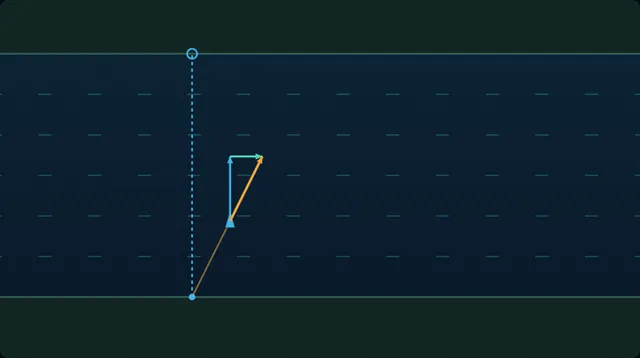
- With Heading from straight across at 0°, watch the boat point straight at the far bank yet land downstream; the amber distance marked along the far bank gives how far.
- Raise the heading so the bow points upstream until its track runs straight up the dotted line to the point opposite; at the default speeds that happens at 30°, where sin θ = v_r/v_b.
- Read 'cross in … s' at the top as you change the heading: it is quickest at 0° and slower the further you turn upstream.
- Push the Current speed slider above the Boat speed slider, or tap Current beats engine, and see that no heading lands the boat straight across.
- Watch the three arrows at the boat: boat velocity through the water, the current added to its tip, and the resultant velocity relative to the bank.
What to notice
- The boat moves along its resultant velocity, the vector sum of its velocity relative to the water and the water's velocity, not along the way it points.
- Only the component of boat velocity across the river decides the crossing time; the current never helps or delays the crossing.
- Pointing straight across gives the shortest time; pointing upstream at sin θ = v_r/v_b gives the shortest path but takes longer.
- If the current is faster than the boat, the drift can be reduced but never cancelled.
The formulas
- t = w / (v_b cos θ)
- Crossing time t for a river of width w (20 m here), boat speed v_b relative to water and heading θ measured from straight across.
- x = (v_r − v_b sin θ) · t
- Downstream drift x, where v_r is the current speed and θ is positive when the boat is turned upstream.
- sin θ = v_r / v_b
- Heading θ that lands the boat directly opposite its start; possible only when v_r ≤ v_b.
Questions
In which direction should a swimmer head to cross a river in the shortest time?
Straight across, perpendicular to the current. The time to cross depends only on the velocity component perpendicular to the banks, v_b cos θ, which is largest when θ = 0. The swimmer then drifts downstream by v_r·w/v_b. In the simulation, the 0° setting with 3.0 m/s boat and 1.5 m/s current lands 10.0 m downstream, as marked on the far bank; the crossing takes 20 m ÷ 3.0 m/s ≈ 6.7 s.
How do you cross a river along the shortest path?
Head upstream at an angle θ to the straight-across line such that v_b sin θ equals the current speed v_r. The upstream part of your velocity then cancels the current and you move straight across, landing directly opposite. The cost is a slower crossing, because only v_b cos θ carries you across. In the simulation, the Aimed for zero drift preset uses θ = 30° and the boat runs straight up the dotted line; the crossing takes 20 m ÷ (3.0 cos 30°) m/s ≈ 7.7 s.
Does a faster current increase the time taken to cross a river?
Not if the boat keeps the same heading. The current flows parallel to the banks, so it adds nothing to, and takes nothing from, the velocity across the river; it only increases the drift. In the simulation, keep the heading fixed and change only Current speed: the boat reaches the far bank in the same time while the amber drift distance changes.
What happens if the river flows faster than the boat can move?
The boat cannot reach the point directly opposite, because even heading fully upstream its velocity cannot cancel the current. It can still cross, and the least drift is obtained by heading so that sin θ = v_b/v_r, upstream of straight across. In the simulation, the Current beats engine preset marks a landing far downstream (35.4 m at its 40° heading), and no heading brings that amber drift to zero.
Related simulations