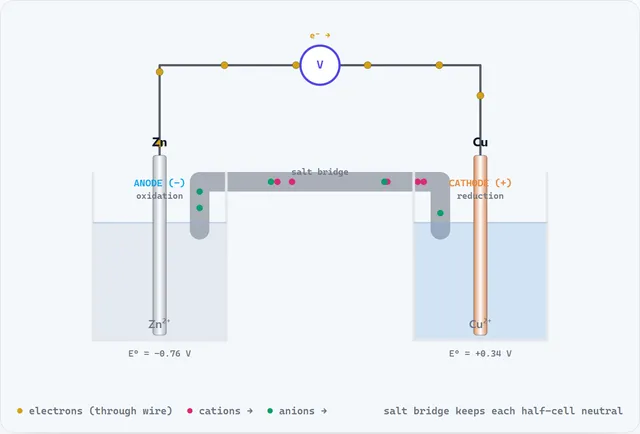
Nernst Equation — Concentration & Cell Potential
Change ion concentrations and temperature and watch the cell voltage drift off E°.
About this simulation
The Daniell cell's voltage plotted as E versus log Q, following the Nernst equation E = E° − (2.303RT/nF)·log Q. Students vary [Cu²⁺] (reactant) and [Zn²⁺] (product) on a log scale and the temperature, watching the operating point slide along the line: excess reactant pushes E above 1.10 V, excess product pulls it below, and the line pivots about log Q = 0 as temperature changes — so temperature only shifts the voltage away from standard conditions. It grounds the equation students otherwise memorise, and previews why E = 0 defines equilibrium.
How to use it
- Start from the 'Standard (Q = 1)' preset: both concentrations are 1 M and the dot sits on the dashed 'E° = 1.10 V' line.
- Lower '[Zn²⁺] anode · product' (the 'Dilute the product' preset) and watch the dot slide left and the cell potential rise above 1.10 V.
- Lower '[Cu²⁺] cathode · reactant' instead and see the potential fall below 1.10 V as log Q becomes positive.
- Change 'Temperature' and watch the line tilt about the point log Q = 0: steeper when hot, flatter when cold, while E° stays at 1.10 V.
- Read E, Q and log Q at the top of the stage, and check them against the equation.
What to notice
- Plotted against log Q, the cell potential is a straight line with a negative slope of 2.303RT/nF, about 0.0296 V per tenfold change in Q for n = 2 at 298 K.
- Increasing the reactant Cu²⁺ or decreasing the product Zn²⁺ raises the potential above E°; the opposite lowers it.
- At Q = 1 the potential equals E° at every temperature, which is why every line passes through the same point.
- Because log Q changes slowly, even a thousandfold change in concentration shifts the Daniell cell's voltage by only about 0.09 V.
The formulas
- E = E° − (2.303RT / nF) log Q
- Cell potential E from standard potential E°, gas constant R, temperature T, electrons transferred n, Faraday constant F and reaction quotient Q.
- E = 1.10 − (0.0591 / 2) log ([Zn²⁺] / [Cu²⁺]) at 298 K
- The Nernst equation for the Daniell cell, with n = 2 and 2.303RT/F = 0.0591 V at 25 °C.
- Q = [Zn²⁺] / [Cu²⁺]
- Reaction quotient for Zn + Cu²⁺ → Zn²⁺ + Cu; the pure solid metals are left out.
Questions
What does the Nernst equation tell us?
The Nernst equation gives the potential of an electrode or cell when concentrations, pressures or temperature are not at standard values. It corrects E° by a term that depends on the reaction quotient Q: E = E° − (2.303RT/nF) log Q. When products build up Q grows and E falls; when reactants are in excess E rises. Move either concentration slider to see the dot slide along the line.
How do you write the Nernst equation for a Daniell cell?
For Zn + Cu²⁺ → Zn²⁺ + Cu, two electrons are transferred and the solids are left out of Q, so E = E° − (0.0591/2) log([Zn²⁺]/[Cu²⁺]) at 298 K, with E° = 1.10 V. If [Zn²⁺] = 0.001 M and [Cu²⁺] = 1 M, log Q = −3 and E = 1.10 + 0.089 = 1.19 V. The 'Dilute the product' preset shows this case.
Why does cell potential become zero at equilibrium?
As a cell discharges, reactants are used up and products form, so Q rises and E falls. When E reaches zero there is no driving force left, no net current flows and the reaction is at equilibrium, with Q equal to K. Putting E = 0 into the Nernst equation gives E° = (2.303RT/nF) log K, the link between standard potential and the equilibrium constant.
What is the value of 2.303RT/F at 298 K and where does 0.0591 come from?
With R = 8.314 J mol⁻¹ K⁻¹, T = 298 K and F = 96485 C mol⁻¹, 2.303RT/F is about 0.0591 V. Dividing by n gives the change in potential for each tenfold change in Q. For the Daniell cell n = 2, so the slope is about 0.0296 V. At 298 K the 'Dilute the product' preset puts log Q at −3 and the dot at 1.189 V, three steps of 0.0296 V above E°.
How does temperature affect the potential of a cell in the Nernst equation?
Temperature appears in the slope term 2.303RT/nF, so a hotter cell responds more strongly to non-standard concentrations. If Q is less than 1, raising the temperature pushes E further above E°; if Q is greater than 1, it pushes E further below. At Q = 1 the correction vanishes. Try the 'Hot cell (373 K)' preset and compare it with 298 K.