Circular Aperture — Airy Rings
Light through a round hole forms a bright disk ringed by concentric halos.
About this simulation
Light passing through a circular aperture spreads into the Airy pattern — a bright central disk surrounded by concentric rings — computed here from the exact Bessel-function form I(u) = [2·J₁(u)/u]². This is the diffraction limit behind the resolving power of every lens, telescope and eye — the Rayleigh criterion is stated in terms of this first dark ring. Students vary the aperture diameter a, screen distance D and wavelength λ, and switch to an Enhanced exposure to reveal the faint outer rings. First dark ring at sinθ₁ = 1.22 λ/a.
How to use it
- Start in the Face-on view: the screen shows a bright central disk with rings, and a dashed circle marks the first dark ring with its radius in millimetres.
- Drag the Aperture diameter slider down, or tap the Pinhole preset, and watch the disk swell; tap Wide aperture and it shrinks.
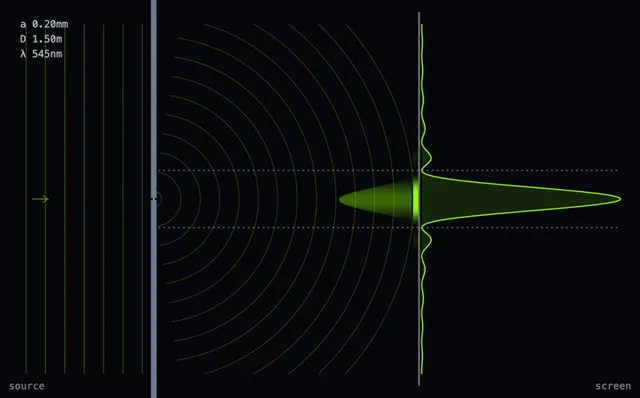
- Switch View to Edge-on to see the intensity profile, with the first three dark rings marked at 1.220, 2.233 and 3.238 λD/a.
- Change Exposure from Enhanced to Linear, or tap As a camera sees it, to see how faint the outer rings really are.
What to notice
- A round hole gives rings, not straight fringes, because the opening has no preferred direction.
- The first dark ring is at 1.22 λD/a, not λD/a as for a slit, and the later dark rings are not evenly spaced.
- The first bright ring is under 2% as bright as the centre, which is why it almost disappears in the Linear exposure.
- A smaller aperture or a longer wavelength makes the Airy disk bigger.
The formulas
- sin θ₁ = 1.22 λ / a
- Angle θ₁ of the first dark ring for an aperture of diameter a and wavelength λ.
- r₁ = 1.22 λD / a
- Radius r₁ of the first dark ring (the Airy disk) on a screen at distance D.
- I(u) = I₀ [2 J₁(u) / u]²
- Airy intensity pattern; J₁ is a Bessel function and u grows with the distance from the centre of the pattern.
Questions
What is an Airy disk?
When light passes through a circular opening, diffraction spreads it into a bright central spot surrounded by fainter concentric rings. The central spot, out to the first dark ring, is called the Airy disk and holds about 84% of the light. Its angular radius is given by sin θ = 1.22 λ/a. In the simulation, the dashed circle on the face-on screen marks the edge of the Airy disk.
Why is there a factor of 1.22 for a circular aperture but not for a slit?
A slit is uniform along its length, so the first minimum is at a sin θ = λ. A circle is narrower near its top and bottom edges than across its middle, so its effective width is smaller than its diameter and the light spreads a little more. Working this out gives a Bessel function whose first zero puts the dark ring at 1.22 λ/a. The Edge-on view labels this zero and the next two.
What is the Rayleigh criterion for resolving two objects?
Two point sources are just resolved when the centre of one Airy disk falls on the first dark ring of the other. Their angular separation is then θ ≈ 1.22 λ/a, where a is the diameter of the lens or mirror. Any closer and the two disks merge into one blur. The simulation shows a single source, so use the first dark ring radius it reports as the size of that blur.
Why do large telescopes have a better resolving power?
Resolving power is the reciprocal of the smallest resolvable angle, 1.22 λ/a, so a larger objective diameter a gives a smaller Airy disk and lets closer stars be told apart. A larger mirror also collects more light. In the simulation, increasing the Aperture diameter shrinks the Airy disk, which is the same effect that makes a big telescope resolve finer detail.